


 Français

Staying in a Loire Valley château can mean very different things. Some châteaux have become hotels with restaurants, spas, concierge services and extensive facilities. Others remain inhabited historic houses, with just a few guest rooms within the old buildings.
These two ways of staying do not necessarily meet the same expectations. A château hotel often puts hotel services and facilities first. In an inhabited château, more of the experience comes from the building itself, its spaces, history and daily life over several days.
For travellers looking specifically for hotel facilities, our article on choosing a luxury hotel near the Loire Valley châteaux considers location, services and how the stay is organised.
Château hotel or inhabited château: two different stays
A château converted into a hotel may offer the services expected of an upmarket establishment: a restaurant, reception, spa, swimming pool, room service or concierge. The historic building provides the setting for a complete hotel operation.
In a château that is still lived in, the approach is different. Rooms form part of a house that retains its own uses, circulation and sometimes an arrangement inherited from centuries of history. They are not necessarily designed to follow one standard layout.
The distinction is therefore not simply a choice between comfort and heritage. It is about what you want from your stay: a wide range of services on site, or a more direct experience of a historic home that is still part of everyday life.
What does it mean to stay in an inhabited château?
In an inhabited historic house, a guest room belongs to the building before it belongs to an accommodation category. Its size, windows, orientation and materials often depend on the part of the château in which it is situated.
Thick walls, staircases, old openings, courtyards and gardens continue to shape the stay. The building is not simply something you see from your room: to some extent, it determines the character of the room itself.
This is part of what makes a stay of several nights in a Loire Valley château different. Gradually, the place becomes familiar rather than remaining the setting for a single night.
Modern comfort and historic architecture can coexist
Staying in an old building does not mean giving up modern comforts. Private bathrooms, comfortable beds, heating and other facilities can be incorporated into a monument without disguising all of its architecture.
What matters is how those additions sit within the existing building. A room can be comfortable while retaining irregular spaces, beams, stonework, small windows or a layout shaped by the history of the place.
La Corroirie: a château-monastery that is still inhabited
At La Corroirie, a former fortified Carthusian establishment between Loches and Montrésor, the buildings retain their connection with the history of the Carthusian monastery of Le Liget. The medieval church, the moat, the former working buildings and the inhabited rooms remain part of the same historic ensemble.
La Corroirie is not a château hotel. Its five guest rooms occupy different parts of the château-monastery, each with its own character.
This is also what distinguishes bed and breakfast accommodation in an inhabited château: a room that still belongs to a home, rather than a space repeated identically along a hotel corridor.
Five rooms, five relationships with the château-monastery
These five rooms are not interchangeable. Their proportions, light and outlook reflect the different parts of the former guesthouse.
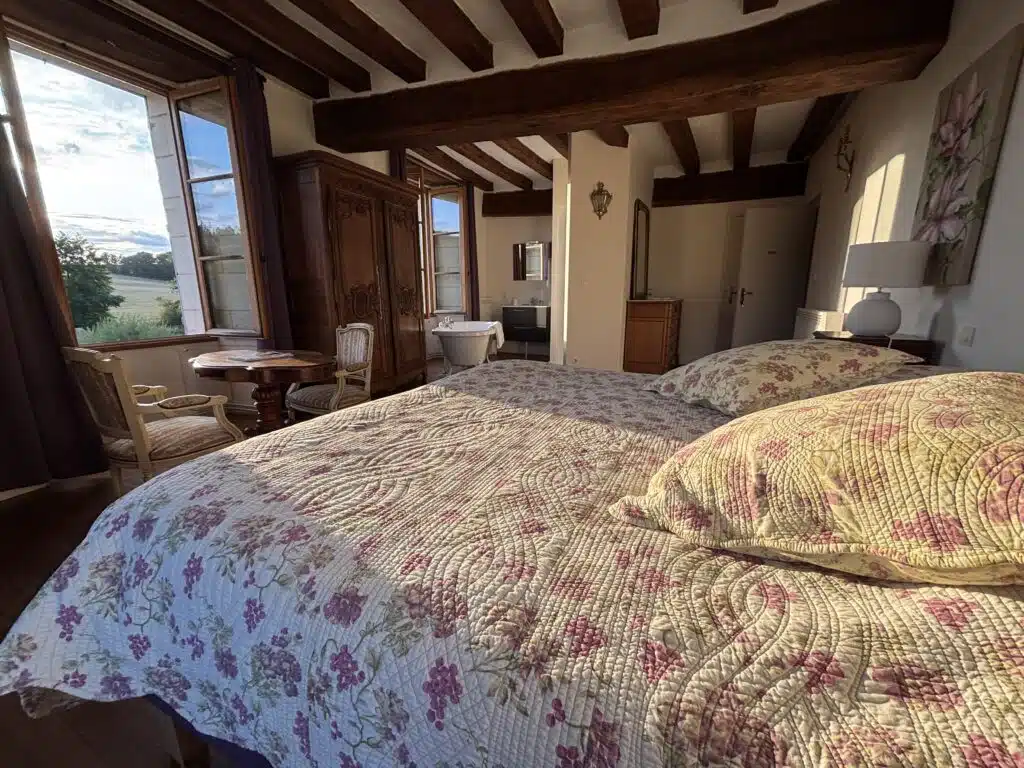
The Pastoral Room
Around 35 m², looking out towards the moat and park. A freestanding bath extends the view towards the trees and evening light.

The Cardinal Room
Around 35 m² overlooking the church and rose garden, with a sitting area, desk and enclosed bathroom with a shower and bath.

The Seigneurial Room
Around 50 m², more inward-looking, where exposed beams, wood and traditional furniture give the room its distinctive character.
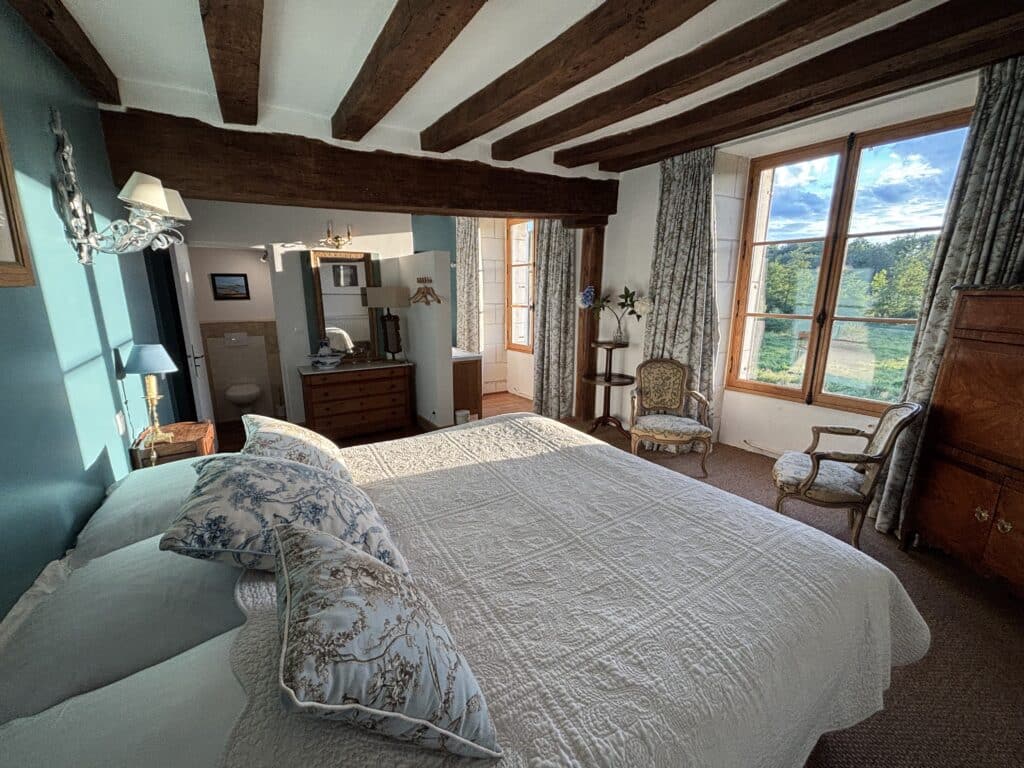
The Monial Room
Around 25 m², light and restrained, with views of the moat, park and horizon. The sleeping area is raised by one step.
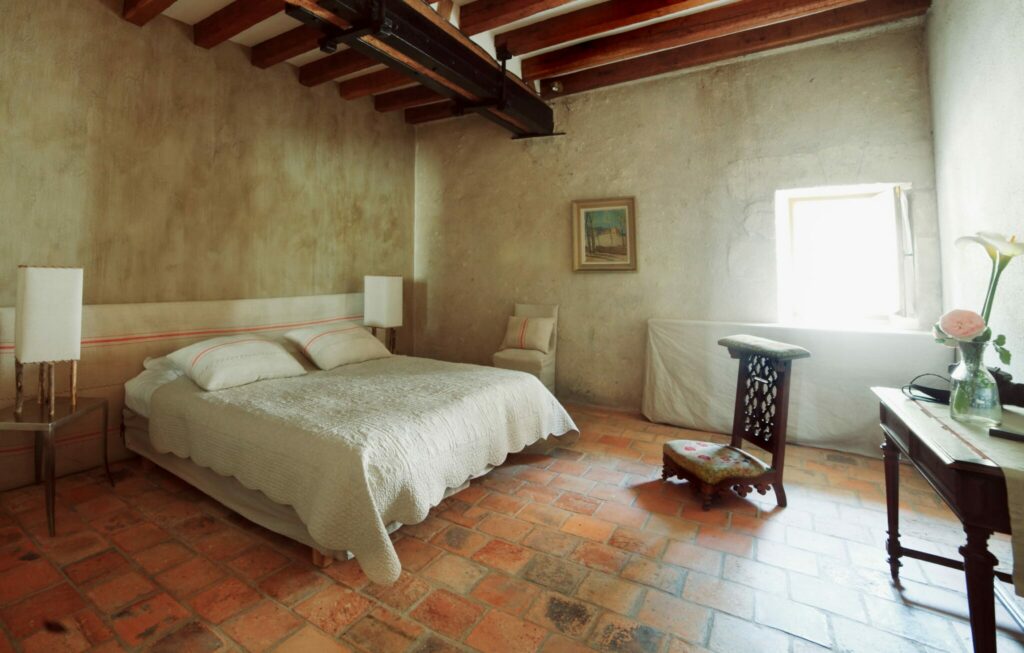
The Monacal Room
Around 25 m², quieter and more secluded within the château. The private bathroom is reached along a short private corridor.
These differences come from the architecture rather than a standard room design. For more photographs, facilities and practical details, explore the five guest rooms of La Corroirie.
Historic accommodation without a medieval re-enactment
Living in an old monument does not mean trying to recreate life from another period. At La Corroirie, the rooms are not designed as medieval stage sets, and a stay is not built around historical performances.
The past is already present in the building: the church, the walls, moat, tiled floors, beams and old windows. The experience comes from the surviving architecture, not from a reconstruction of another age.
Choosing a château as a base for exploring Touraine
The type of accommodation is only part of the decision. Location also matters if you hope to visit several Loire Valley châteaux during the same stay.
From La Corroirie, you can plan days in the Royal City of Loches, in the village and château of Montrésor or at the Château de Chenonceau, before returning to the same château-monastery in the evening.
The question of where to stay when visiting the Loire Valley châteaux is closely linked to how long you stay. Several nights allow you to spread out the visits without repeatedly changing accommodation.
How to choose between a château hotel and an inhabited château
Before booking, it helps to ask yourself a few questions:
- Do you want a restaurant and a wide range of services on site?
- Do you want the historic building itself to be part of the experience?
- Would you prefer a hotel operation or a home that is still inhabited?
- Are you staying for one night or several days?
- Which châteaux, towns and parts of Touraine would you like to visit?
These questions are more useful than relying on labels such as “luxury” or “authenticity” alone.
Choose the kind of Loire Valley château stay that suits you
There is no single way to stay in a Loire Valley château. Some travellers prefer the services of a high-end hotel. Others are drawn to an independent historic house, bed and breakfast accommodation or a château that remains inhabited.
Our guide to choosing where to stay in a Loire Valley château looks more broadly at the different kinds of properties, their locations and the length of a visit.
Others may choose a different kind of Loire Valley château stay, where the place in which they sleep is also part of the days spent exploring the region.
For a closer look at this way of staying, our article about staying at La Corroirie château-monastery introduces the historic buildings, their guest rooms and the location between Loches and Montrésor.