

 Français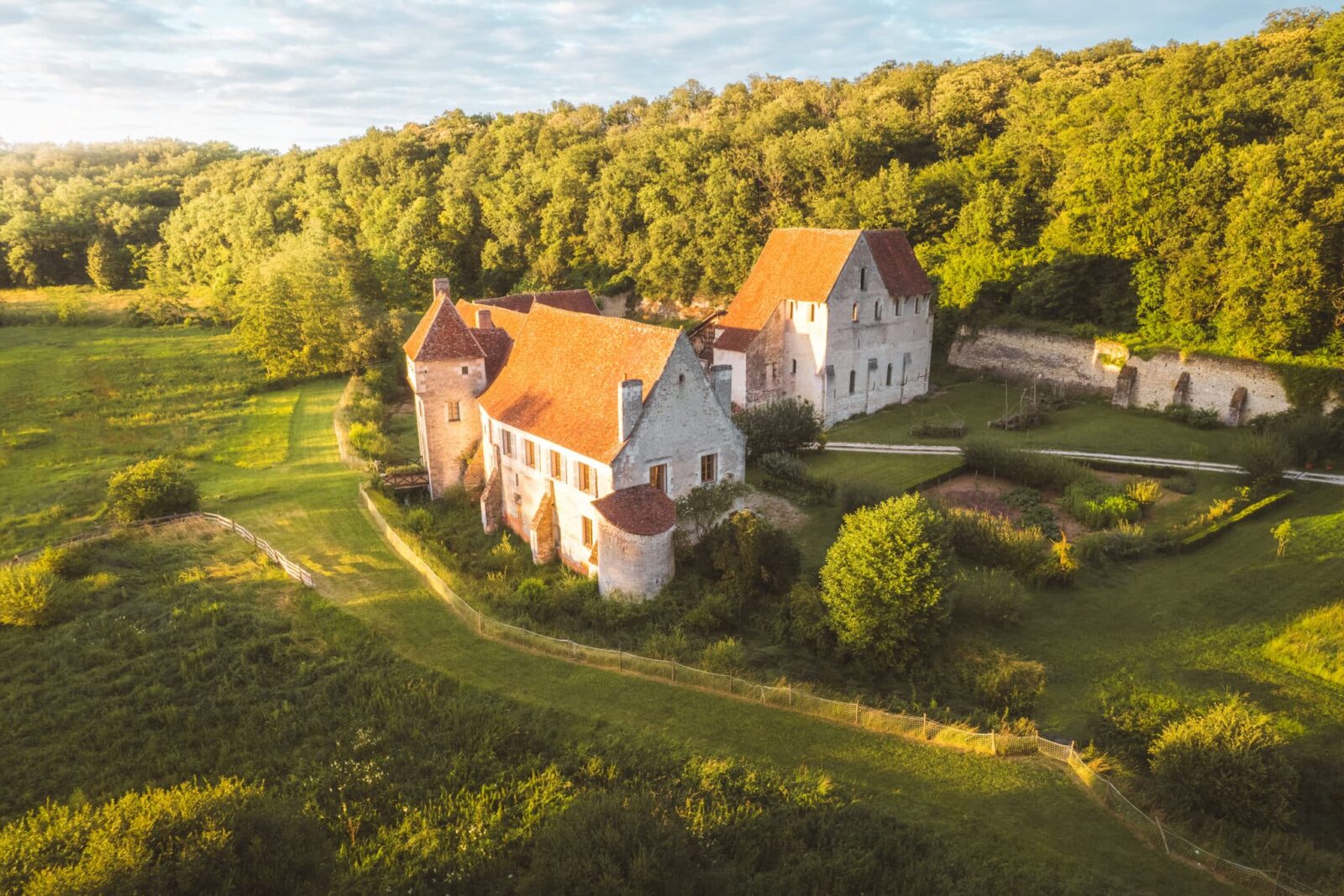
Visiting La Corroirie
La Corroirie is not visited like an isolated monument. It is discovered gradually, as one moves between the buildings, the moat and the landscape, within a place that is still inhabited. When the Carthusians settled here, the land was still open, without the balance perceived today. Little by little, they shaped the territory – digging ponds, organising the land, planting forests. What one crosses here is the result of that slow work, still legible in the landscape.
The self-guided visit allows visitors to move through the site as a whole: from the church consecrated in 1206 to the former buildings of the brothers, through the old circulations, the uses of the place and the Vox Alchimia Land Art trail.
Those who wish to extend this approach may also encounter another dimension of the place through the distillery, where contemporary gestures continue the history of La Corroirie without breaking it.
A brochure is provided on site. It does not impose a route, but gives landmarks: one may read a passage in front of the church, return towards the moat, stop by the cellar, then continue later. The visit keeps something open and unhurried.
La Corroirie is still inhabited. This changes the way it is approached: one does not enter a frozen setting, but a place maintained, restored and crossed every day by simple uses.
To go further, it is possible to consult the Wikipedia page dedicated to La Corroirie as well as the archaeological study published in the Revue Archéologique du Centre de la France.
The visit is open from April 1st to November 11th, every day from 11 am to 7 pm. A contribution of €5 is requested for adults; it helps preserve the site and keep it open. Guided visits may be arranged by appointment for those who wish to enter more deeply into the history of the place (€12).
Entering the history of La Corroirie
Beyond the visit itself, some choose to enter the depth of the place.
What follows is not a route to follow, but a body of memory to move through. Buildings, old uses and passages appear differently, as layers still present in the stone.
One may stop there, return to them, or keep only fragments – as one does when walking through the estate.

La Corroirie within the Charterhouse of Le Liget
Origin and organisation
In 1178, at the edge of the Forest of Loches, on land given by the Abbey of Villeloin, Henry II Plantagenet founded the Charterhouse of Le Liget, in expiation for the murder of Thomas Becket.
The new monastery soon received many donations, including the feudal fief of Craçay. This became the monastery of the brothers, known among the Carthusians as La Corroirie. The word comes from the Carthusian Latin conredium or conredia, meaning what serves the maintenance of the monks. This place gave the lay brothers seigneurial powers that were unusual for a religious order.
The Carthusian order distinguished between the Fathers, who lived enclosed within the Charterhouse in silence and prayer, and the Brothers, who divided their life between common prayer and manual work at La Corroirie.
The brothers prayed in the church and worked in the fields or in the cellar. They were placed under the authority of the prior, who appointed a Father Procurator to administer the estate. The Father Procurator lived at La Corroirie and exercised the rights attached to the feudal fief, making the site both a monastic house and a centre of seigneurial administration.
The lay brothers took the same vows as the Fathers, but could not become Fathers themselves. Their humility allowed the community to live in peace. Literate, autonomous and free adults, they managed the land, resources and people attached to the estate.
Other people also lived here: the donats or oblates, who came to atone for faults or fulfil a vow, adopted the rules of the brothers. Agricultural workers were paid employees, without a religious function. The estate also had a bailiff, a sergeant, a lawyer and a fiscal procurator, proof of its judicial autonomy.
From the fifteenth century, Charles VII placed a captain and a garrison here. Pilgrims also passed through on their way to Compostela or Tours, finding shelter in the hostelry of La Corroirie.
La Corroirie and the house of the Fathers together formed the Charterhouse of Le Liget. La Corroirie was the monastery of the brothers, but also the administrative and seigneurial centre of the estate, and could serve as a place of refuge for the Carthusian Fathers when circumstances required it.
The church and the cellar
The church
Built at the beginning of the thirteenth century, the church was consecrated in 1206 by Eudes de Sully, Archbishop of Paris, in the presence of King John of England.
Its architecture belongs to the Plantagenet style: a single nave, high domed vaults with eight ribs, and a seven-sided chevet. Originally, the floor lay about one and a half metres lower, and the windows were probably left clear, allowing a more direct light to enter.
A Renaissance liturgical piscina, set into the wall, allowed the celebrant to wash his hands after communion. The fresco in the choir is more recent, dating from 1935.
The cellar
Extending from the church, the cellar develops a sober Gothic architecture: two naves, four central columns and large volumes once used for storage and work.
An old wine press recalls the presence of vines on the surrounding slopes. In the fifteenth century, the addition of a granary floor weakened the structure, leading to the raising of the ground level in order to support the weight of the harvests.
The space was also used in the preparation of parchment and paper, made from plant fibres, for the copyists of the Charterhouse.
This organisation still helps explain the site today: the château occupies one part of La Corroirie, while the monastic centre, with the church and the former buildings of the brothers, lies within the fortified ensemble. The expression château-monastery therefore describes two realities that have long coexisted within the same place.

The estate and its uses

Corroirie means “what serves maintenance”. The estate formed a considerable whole: land, forest, ponds, vines and meadows, spread around about twenty tenant farms.
The land fed the brothers: cereals, vegetables and fish from the ponds. The oak forest, planted methodically, was an essential resource. Hemp was also everywhere – for ropes, clothing, paper, and sometimes as a resource in times of scarcity.
Henry II encouraged this strategic crop for his fleet. The fibres served for ropes, the seeds for people and animals. Medieval pharmacopoeia itself attributed calming properties to hemp.
The mills
Two mills followed one another at the end of the cellar. Their presence may predate the arrival of the Carthusians, and one of them remained in use until the nineteenth century. Fed by the Aubigny stream and the pond upstream, they served only the needs of the monastery.
The stone channel still visible today carried water towards a large wheel, driving a millstone that has now disappeared. A second space housed another wheel, whose use could be regulated by a system of sluices.
The granary
Above, the granaries created in the fifteenth century received the harvests. A drawbridge allowed farmers to bring in the dues owed to the estate.
A local market was held there. A specific measure, the “boisseau de la Corroirie”, was used. Among the activities, barrel-making from the oak of the nearby forests held an important place.
Power and fortifications
La Corroirie was not only a place of work and prayer. Established on a feudal fief, it also possessed seigneurial and judicial rights, exercised from the site alongside its monastic functions.
Justice was administered here, and the estate formed an unusual combination of religious, agricultural and feudal authority. This helps explain why La Corroirie developed not only as a monastery of the brothers, but also as a fortified seigneurial site.
The small tower
Isolated to the north, between the cellar and the walls, the small tower served as a prison, but also as a hemp-drying place. A single opening on the upper floor gave access, and latrines can still be seen.
At certain periods, its use changed: hemp, after retting in the stream, was dried there before being worked in the mill and cellar.
The moat and defences
La Corroirie was protected by a moat, ramparts and living hedges. The north and east walls still remain today.
The arrow slits bear witness to different periods: stirrup-shaped in the thirteenth century for archers, exclamation-mark-shaped in the fifteenth century for firearms. Gunports then appeared with artillery.
During the Hundred Years’ War, La Corroirie served as a refuge. In 1432, Charles VII authorised the Carthusians, by virtue of their fief of La Corroirie, to fortify the site and maintain a garrison there. The defensive dimension of the place is still visible in its moat, walls, firing positions and fortified buildings.

A place restored, transmitted and still inhabited

During the French Revolution, the Charterhouse was closed. La Corroirie, sold as national property, became an agricultural estate. This transformation nevertheless helped preserve much of the buildings, which continued to be used instead of being abandoned.
In 1899, the ensemble was bought by René de Marsay, heir to the Charterhouse. His nephew Henry succeeded him in 1919, then passed the place on in 1982 to his daughter, the Countess Guy de Mareüil, who undertook a major restoration campaign.
A quarter of a century ago, at the age of twenty-five, Jeff de Mareuil chose to live here and reopen the doors. The place recovered a form of welcome – not as a transformation, but as a continuity: inhabiting, receiving, letting time settle.
That continuity can still be felt in the way La Corroirie is inhabited today. Our articles about living at La Corroirie explore the rooms, daily rhythms, history and quiet presence of a monument that has never become a place apart from life.
In the past, pilgrims passed through on their way to Compostela or Tours. Those who come today no longer always bear that name, but sometimes continue, in another way, the same movement of approach, pause and passage.
Plan of La Corroirie
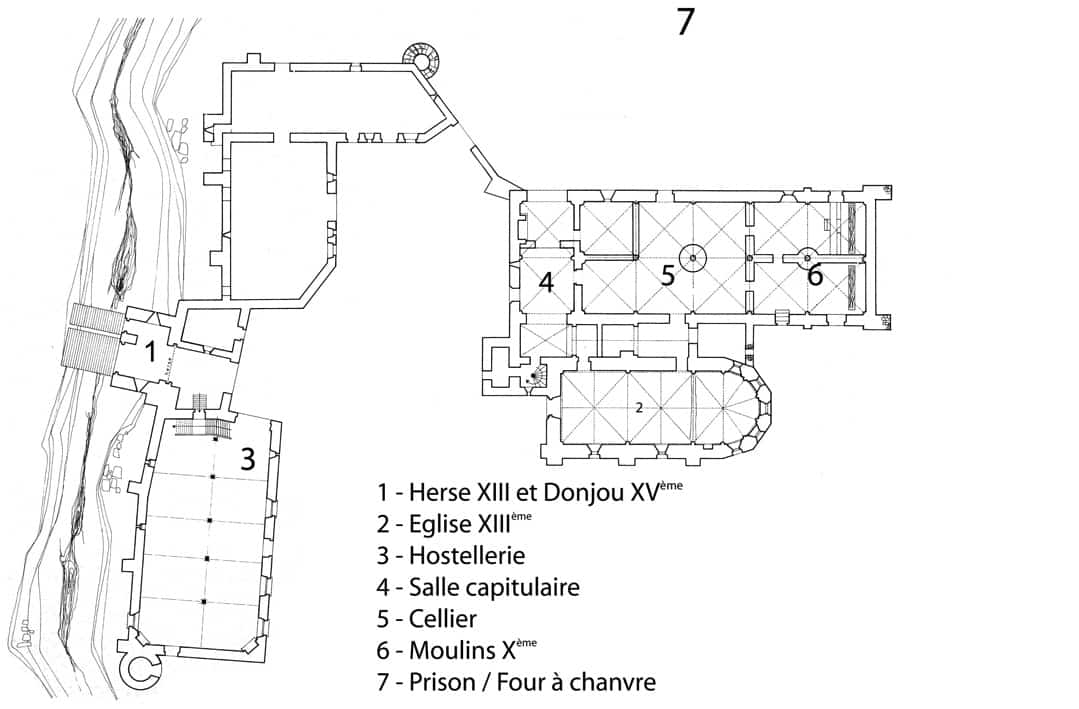
Before coming, the brochure offers another way of entering the place, moving through its layers and approaching its history.
FAQ – Visiting La Corroirie
Can La Corroirie be visited without staying overnight?
Yes. La Corroirie can be discovered freely, without staying on site. Yet staying for a few days allows one to approach other moments of the place – morning, evening, and the hours when it returns to its own rhythm. Stay within the château-monastery
Is booking required for the visit?
No. When the drawbridge is open, the visit is possible. A brochure is available on site and accompanies the discovery. Each visitor then moves at their own pace, without a fixed route.
What are the opening times?
La Corroirie is open from April 1st to November 11th, every day from 11 am to 7 pm. Outside this period, the place becomes more discreet, though it may sometimes open in another way.
How much does the visit cost?
A contribution of €5 is requested. It simply helps maintain the site and preserve the continuity of what is lived here.
Can visitors come with a dog or a bicycle?
Yes. Dogs kept on a lead may circulate outside. Bicycles naturally find their place in the courtyard during the visit.
Is there parking on site?
A parking area is available at the entrance to the estate. The approach to the site is slow, like a transition into the place.
Can an event or a photo shoot be organised at La Corroirie?
The place can open to certain forms of presence: concerts, photo shoots or shared moments. Each project is prepared individually, with respect for the balance of the site. Approach a private use of La Corroirie
Can the distillery be visited?
The distillery is not open continuously. It opens occasionally, during particular moments – visits, encounters or tastings. It extends the place through other gestures, linked to plants and seasons. Approach the distillery
Is there an archaeological study of La Corroirie?
Yes. A study was published in the Revue Archéologique du Centre de la France. It helps place the site within a longer historical reading, beyond the visit itself.