

 Français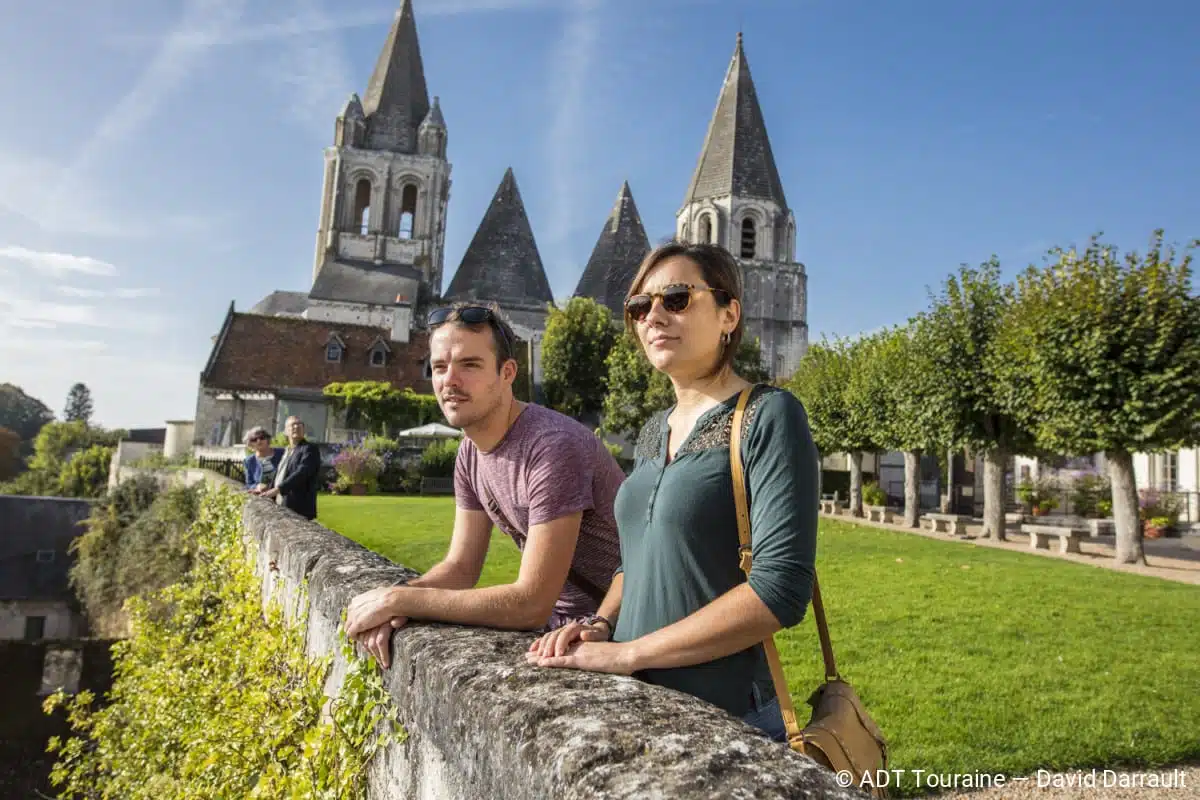
Visiting Loches from La Corroirie: royal city, museums and market
From La Corroirie, reaching Loches means leaving the woodland and moat of the château-monastery for a few hours and entering a town built on height, where centuries of history remain unusually visible in the stone.
The journey through Touraine is a gradual one. Fields, the edges of the Forest of Loches and small villages lead towards the royal city, its keep, the royal residence and the Collegiate Church of Saint-Ours.
Yet Loches is more than its medieval enclosure. The lower town also holds museums, unexpected collections and two paintings known as the “Caravaggios of Philippe de Béthune”, whose history leads directly back to the Carthusian monastery of Le Liget and La Corroirie.
Its proximity to La Corroirie makes it possible to return to Loches several times during the same stay: one day for the royal city and its museums, a Wednesday or Saturday morning for the market, another simply to walk through the town.

The Royal City of Loches
Reaching the royal city begins with the climb. The streets narrow, the lower town falls behind, and the fortified ensemble gradually appears above the Indre valley.
The keep of Loches preserves the massive presence of the Middle Ages. The royal residence tells a different story, connected with the lives and passages of the French kings and their court.
Between them, ramparts, gateways, old houses and gardens give the royal city a coherence that extends beyond any single monument.
Loches therefore belongs naturally among the places to discover from La Corroirie and forms an essential part of our Treasure Route through southern Touraine.

Saint-Ours, Agnès Sorel and medieval Loches

The Collegiate Church of Saint-Ours brings a very different presence to Loches from that of the keep. Its Romanesque architecture, sculpted portal and especially its two extraordinary pyramidal stone roofs, known locally as the dubes, make the building immediately recognisable.
The church also contains the tomb of Agnès Sorel, favourite of Charles VII, whose life remains closely associated with Loches and the royal court of the fifteenth century.
This proximity between religious architecture, royal power and an inhabited town finds an echo, on another scale, in the history of La Corroirie and the Carthusians of Le Liget. In both places, buildings cannot be separated from the lives, uses and works that passed through them.
In Loches, works that came from the Carthusian monastery of Le Liget
A visit to Loches reveals an unexpected continuation of the history of La Corroirie. The Galerie Saint-Antoine now preserves several works that came from the Carthusian monastery of Le Liget, the monastic ensemble to which La Corroirie belonged as the house of the lay brothers and the administrative centre of the estate.
The “Caravaggios of Philippe de Béthune”
Two early seventeenth-century paintings hold a particular place in this story: The Supper at Emmaus and The Incredulity of Saint Thomas, known as the “Caravaggios of Philippe de Béthune”.
They belonged to Philippe de Béthune, French ambassador in Rome from 1601 to 1605, before being entrusted to the Carthusians of Le Liget, whose estate was administered through La Corroirie.
Their presence in Loches is therefore the end of a journey that passes through Rome, Le Liget and La Corroirie. After the French Revolution and the dispersal of the Carthusian possessions, the paintings were transferred to Loches, where they have remained.
Their attribution directly to Caravaggio has a complex critical history, which is why the careful designation “Caravaggios of Philippe de Béthune” remains useful. Their connection with Philippe de Béthune and the Carthusian monastery of Le Liget, however, forms an essential part of their history.
The Altarpiece of Le Liget
The Galerie Saint-Antoine also preserves the remarkable Altarpiece of Le Liget, a fifteenth-century triptych attributed to Jean Poyer. It too came from the Carthusian monastery.
These works are therefore more than isolated treasures encountered in Loches. They tell a story of patrons, collections and objects moving through the same territory over several centuries.
This circulation of works is one of the threads followed by our Treasure Route around La Corroirie, which reconnects works and monuments with the places from which their history emerged.
The two paintings and the Altarpiece of Le Liget can now be seen at the Galerie Saint-Antoine in Loches.
The Lansyer Museum and the Chancellerie
Entering the home of Emmanuel Lansyer
Within the royal city, the Lansyer Museum occupies the family home of the landscape painter Emmanuel Lansyer, who lived from 1835 to 1893.
A pupil of Viollet-le-Duc and Gustave Courbet, Lansyer left Loches an important part of both his work and his collections. The house reveals not only the painter and his landscapes, but also the private world in which these works and objects were gathered.
Paintings, prints, photographs, personal objects and a collection of Asian art make this a more intimate encounter than the large monuments of the royal city. It is another way of entering Loches, through the eyes of an artist deeply attached to the town.
The Chancellerie, another way into the history of Loches
On rue du Château, the Chancellerie retains a remarkable Renaissance façade. It houses an interpretation centre devoted to the architecture and heritage of Loches, together with temporary exhibitions.
Its courtyard and exhibition spaces also provide a pause between the lower town and the royal city, a place to stop before continuing through Loches.
The Loches market on Wednesday and Saturday mornings
Loches changes rhythm on Wednesday and Saturday mornings. From 8 am to 1 pm, the market spreads through the centre of town and brings together producers, food traders and other stallholders.
It is one of the moments when the surrounding territory becomes most tangible. Market gardeners, bakers, butchers, cheesemakers and local producers bring into the streets of Loches much of what is grown and made in the surrounding countryside.
Depending on the season, one may encounter Sainte-Maure-de-Touraine AOP goat’s cheese, Géline de Touraine poultry, rillons, Rillettes de Tours, breads, dairy products and other foods rooted in the Lochois and Touraine.
From La Corroirie, a market morning gives the day another rhythm: taking time among the stalls, staying for lunch in Loches, then climbing towards the royal city or choosing a museum for the afternoon.
This relationship with the produce and tables of the region continues in our restaurants and gastronomy around La Corroirie.
For practical information and any seasonal changes, consult the official Loches market page.
A day in Loches from La Corroirie
Loches can occupy a full day without needing to add another major site immediately afterwards.
- On Wednesday or Saturday, begin with the Loches market
- Climb towards the keep and royal residence
- Enter Saint-Ours and find the tomb of Agnès Sorel
- Descend towards the Galerie Saint-Antoine and the works once held at Le Liget
- Spend time at the Lansyer Museum or the Chancellerie
- Leave space for the streets, squares and lower town
- Return in the evening through the Forest of Loches towards La Corroirie
Loches within a stay of several days in Touraine
The closeness of Loches and La Corroirie means that the royal city need not become a single stop on an itinerary. One can return for the market, devote another day to the monuments, or come back to a museum that there was not time to enter before.
Other days can lead towards Montrésor and the Indrois valley, towards Chenonceau and the River Cher, or towards the ZooParc de Beauval.
Some days can remain almost empty: a path through the Forest of Loches, a visit to La Corroirie, time beside the pond, or a few unplanned hours within the estate.
This alternation is what gives coherence to a longer stay: discovering very different places without changing one’s point of return each evening.
Returning from Loches to La Corroirie
The return from Loches does not close the day. Streets, collections and the royal city gradually give way again to forest, meadows and moat.
At the château-monastery, evening returns to another measure. There may still be time to walk, read, watch the light settle on the old stone, or simply remain.
Loches becomes less an excursion from La Corroirie than part of the surrounding territory that one gradually learns to inhabit.
Questions about Loches
What should I see in the Royal City of Loches?
The keep, royal residence and Collegiate Church of Saint-Ours form the heart of the royal city. The ramparts, old streets and tomb of Agnès Sorel extend the visit beyond these three monuments.
What is the connection between the Caravaggios in Loches and La Corroirie?
The two paintings known as the “Caravaggios of Philippe de Béthune” belonged to Philippe de Béthune before being entrusted to the Carthusians of Le Liget. La Corroirie was the house of the lay brothers and played a central role in the administration of the Carthusian estate. After the French Revolution, the paintings were transferred to Loches, where they are now displayed at the Galerie Saint-Antoine.
Where can the Caravaggios be seen in Loches?
The Supper at Emmaus and The Incredulity of Saint Thomas, known as the “Caravaggios of Philippe de Béthune”, are displayed at the Galerie Saint-Antoine together with the Altarpiece of Le Liget.
Which museum should I visit in Loches?
The Lansyer Museum preserves the home, works and collections of the landscape painter Emmanuel Lansyer. The Galerie Saint-Antoine and the Chancellerie offer two further ways of approaching the artistic and architectural history of Loches.
Which days is the Loches market held?
The Loches market is held in the centre of town on Wednesday and Saturday mornings, from 8 am to 1 pm.
Where can I stay to discover Loches without rushing?
La Corroirie, between Loches and Montrésor, provides the same point of return for several days while discovering the royal city, its museums, market and the wider landscape of southern Touraine.